You may learn more about the biodiversity of our Gunung Leuser National Park by joining our ethical jungle trekking in Bukit Lawang, North Sumatra. We usually include both daytime and nighttime hikes in our jungle trekking packages. Our herping tour, which follows a day of hiking to search for wild and semi-wild orangutans in Bukit Lawang, is the second most popular activity for snake enthusiasts and herpetologists.
Looking For Semi-wild and Wild Sumatran Orangutan.
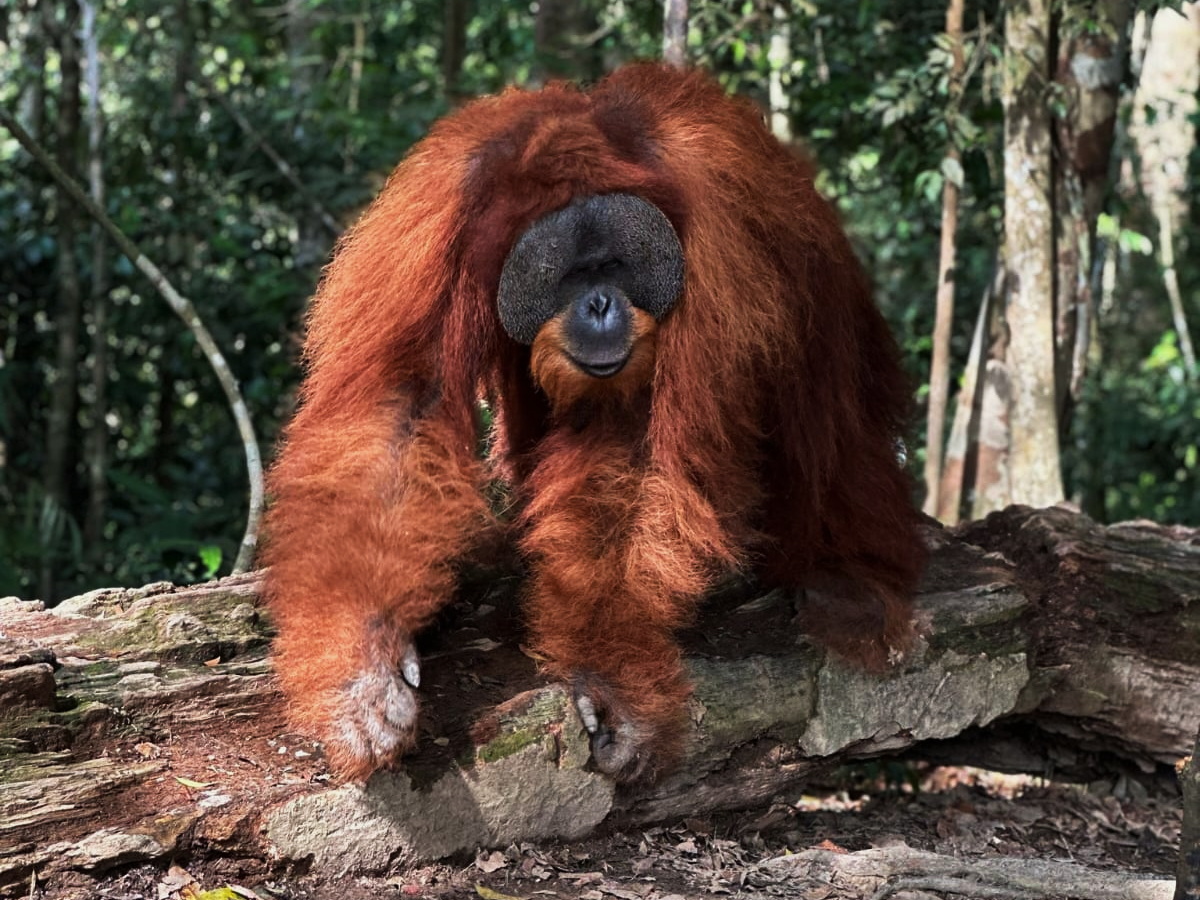
Since most of the jungle trekking in Bukit Lawang focuses on semi-wild orangutans—whose behavior also influences the behavior of wild orangutans in Bukit Lawang—the wild Sumatran orangutan there is generally still little known. There is extremely little chance that you will come across true wild orangutans in Bukit Lawang that do not exhibit adaptive behavior. We are always up for the challenge of searching Bukit Lawang for the actual wild Sumatran orangutans through our jungle trekking, particularly to witness and understand their true-wild behavior, which keeps them perched on treetops and even makes it harder to spot them because they never interact with humans (rare interspecies interaction).
Conservation-Based Ecotourism: Responsible Jungle Treks and Tours.
In a workshop on identifying key biodiversity areas held in Banda Aceh, it was revealed that at least 243 fauna and flora are threatened with extinction in Sumatra. The endangered biodiversity consists of 29 species of birds, 38 species of mammals, 8 species of amphibians, 12 species of reptiles, 14 species of fish, and 142 species of plants. One level of threat to the species is the ongoing destruction of habitats or forests.
From the results of the analysis, it is estimated that the forests of Sumatra, especially the lowland forests, will be severely damaged if significant conservation actions are not carried out to inhibit, or even stop the rate of forest destruction, 1.4 million hectares per year. Because of that, it is necessary to identify biodiversity areas to be used for conservation-based ecotourism. Sumatra has a hotspot, namely an area that has a high level of biodiversity but also faces a high level of threat. There are 24 hotspots in the world, two of which are in Indonesia, namely the Sundaland and Wallacea hotspots. Sumatra is included in the Sundaland hotspot which shows that Sumatra has high diversity but is also accompanied by a high level of threat to biodiversity.
In order to avoid having a detrimental influence on the ecosystem, it is crucial to conduct jungle trekking and tour activities ethically by paying attention to our attitudes in the jungle during the activities. SUMECO, an organization dedicated to wildlife conservation, places a high value on eco-friendly principles.
The Exploration of Leuser’s Biodiversity Through Jungle Trekking in Bukit Lawang.
With its allure of unparalleled variety, Gunung Leuser National Park is referred to as the “lungs of the world.” This national park is one of the biggest flora and fauna protected areas in Southeast Asia, administratively including districts in Aceh and North Sumatra. The vegetation of the Gunung Leuser National Park (TNGL) region comprises Sumatra’s flora from the standpoint of biodiversity.
Flora of Gunung Leuser National Park.
The vegetation of Gunung Leuser National Park shares a strong relationship with that of the Malaysian Peninsula, Borneo, Java, and even the Philippines. Gunung Leuser National Park is home to 3,500 different varieties of plants. According to a quote from the official website of Gunung Leuser National Park, the bioclimate (an elevation climatic zone with a variety of floristic formations) is one of five factors used to define the natural vegetation formations. The connections between floristic composition and biogeography, hydrology, bedrock type, and soil make up the other four criteria.
Fauna of Gunung Leuser National Park.
Gunung Leuser National Park is known to be one of the ecosystem areas in the world with the most biodiversity. Sumatran Island belongs to the Malaysian subregion in terms of animal geography. The abundance of species in Gunung Leuser National Park is mostly concentrated in regions that are between zero and one thousand meters above sea level in elevation.
Gunung Leuser National Park and the surrounding area known as the Leuser Ecosystem Area are the habitats of the Sumatran elephant (Elephas maximus sumatranus), Sumatran tiger (Panthera tigris sumatrae), Sumatran rhinoceros (Dicerorhinus sumatrensis), Sumatran orangutan (Pongo abelii), siamang (Hylobates syndactylus), white handed gibbon (Hylobates lar), and Thomas langur / kedih (Presbytis thomasi).
Ethical Way.
Ethical jungle trekking and orangutan conservation are closely connected because responsible tourism can help protect both the rainforest and the wildlife living in it. Orangutans possess a unique connection with humans due to our numerous similarities. 97% of this primate’s DNA is identical to that of humans. In addition to genetic connections, orangutans display both social and solitary behaviors, and their social structures have become an existence of apes’ lifestyles through their long evolutionary and adaptation processes. When we talk about a genetic similarity of 97 percent, then we have to be able to understand the zoonotic potential that exists. So being knowledgeable, responsible, and ethical is extremely important to any decision-making in tourism activities such as jungle trekking in Bukit Lawang, specifically inside Gunung Leuser National Park.
SUMECO (Sumatra Ecoproject) is a wildlife conservation organization based in Bukit Lawang, North Sumatra. We are committed to conducting ethical and responsible tourism activities to support the preservation of the biodiversity of Gunung Leuser National Park. It is reasonable to assert that excessive jungle trekking or nature tourism, without a tangible benefit to the environment, cannot be deemed ethical or responsible tourism.
Ethical tourism is among the most rapidly expanding businesses globally and significantly contributes to the economic growth of several nations. The rise of ethical concerns in tourism necessitates a more responsible and sustainable approach to the sector. Ethical conduct in tourism pertains to the evaluation of the repercussions of activities on society, culture, and the environment. The process includes making decisions that consider the impacts of all activities on stakeholders, including visitors, employees, employers, local communities, and the states themselves.


The Ethical and Responsible Tourism
Ethical jungle trekking represents a significant advancement and predominates relevant keywords on Google and other search engines, mostly undertaken by visitors with a heightened understanding of ethical tourism practices. SUMECO maintains its emphasis on ecotourism, a nature-centric tourism model designed to aid in the preservation of the natural environment and conservation of local wildlife, typically characterized by minimal impact, while also facilitating contributions to conservation and environmental education.
The growing human population makes it more difficult for the low-human-resource countries to provide sustainable jobs for their own people. Sumatra is the sixth largest island in the world, located in Indonesia, with an area of 473,481 km². The population living on this island is around 59,977,438 people (2023 census). Deforestation in Sumatra is often regarded as a common consequence of the expansion of the palm oil business, approved by the government to promote economic growth. This is the biggest challenge for Sumatra’s tropical rainforests to maintain their protected status. Realistically, based on the field study that SUMECO has conducted since 2010, we cannot deny that only the tourism industry is capable of slowing down the expansion of the palm oil plantation industry.
The negative environmental impacts of tourism are not more substantial compared to the massive organized deforestation in Sumatra. Tourism may often put pressure on natural resources through over-consumption, often in places where resources are already scarce, but it’s not going to be worse than the deforestation that is conducted by abandoned people due to poverty and over-consumption by massive mining, logging, and palm oil industries that create more pollution and environmental damages.
We admit the environmental impacts of tourism have gained increasing attention in recent years. Positively, responsible travelers and educated people are beginning to pay more attention to sustainable tourism, and with an increased number of initiatives for being environmentally friendly, tourists and stakeholders alike are now recognizing the importance of environmental management in the tourism industry.
An ethical jungle trek tied to conservation isn’t just about hiking; it’s about supporting ecosystems and the people who protect them. An ethical trek always minimizes environmental impact and respects wildlife and local culture. Ethical jungle treks have to be about how your presence contributes to (or doesn’t harm) the ecosystem and the people who live there. In regions like Sumatra, this is especially important because of its rich biodiversity and vulnerable habitats.
There Will Be No Ethical Tourism,
WITHOUT Conscious Travelers
sumatran
tiger
in Gunung Leuser National Park


Attributes or Ethical Standards of a Tour Guide
The tour guide represents the standards of the company in ethical tourism
- Must exhibit warmth and convey excitement.
- Must consistently demonstrate a commitment to providing exceptional assistance and high-quality service to all visitors while affording them the chance to experience or visit their selected destinations.
- Shall not discriminate in providing services to any tourist on any grounds, including but not limited to color, gender, ethnicity, nationality, physical disability, age, etc.
- Must be neutral, unbiased, and constructive, representing his/her nation objectively.
- Must be appropriately attired and presentable at all times.
- Must consistently exhibit punctuality, reliability, honesty, conscientiousness, and tactfulness.
- Must be a responsible driver while operating vehicles.
- Shall execute the tour program/itinerary to the best of his/her ability and remain loyal to the company/organization he/she represents.
- Will address disagreement with sensitivity and responsibility.
- Must notify any event of injury or fatality to the nearest tourism authority or police station.
- Must possess expertise and guide travelers without disseminating inaccurate information.
- In the case of unfamiliarity with or inability to supply required information to a tourist, one must seek the competent authorities for help.
- Must never be under the influence of alcohol or narcotic substances while on duty and must abstain from providing any medicine to a client without appropriate medical advice.
- Shall refrain from soliciting clients or gratuities.
- Must always prioritize the safety of the visitor.
- Must have the requisite tourist guide badge and possess his/her registration card.
- Will regard all individuals, cultures, and the environment with respect.
✴︎ ethical jungle trekking
to see Sumatran orangutans and other wildlife in bukit lawang
Price:
- 1 day jungle trek to see Sumatran orangutans, costs 70 EUR per person (min 2 people).
- 2 days and 1 night jungle trek to see Sumatran orangutans, costs 120 EUR per person (min 2 people).
- 3 days and 2 nights jungle trek to see Sumatran orangutans, costs 170 EUR per person (min 2 people).
- 4 days and 3 nights jungle trek to see Sumatran orangutans, costs 250 EUR per person (min 2 people).
- 5 days and 4 nights jungle trek to see Sumatran orangutans, costs 320 EUR per person (min 2 people).

ETHICAL JUNGLE TREKKING & ORANGUTAN CONSERVATION
Conservation and ethical jungle trekking go hand in hand at Bukit Lawang. In addition to supporting local populations that rely on sustainable tourism, ethical jungle trekking contributes to the preservation of wildlife habitats and the rainforest. By selecting ethical excursions, tourists may respectfully and ecologically enjoy the jungle’s natural beauty while also supporting conservation efforts. By promoting safe viewing distances, lessening the influence of humans on animals, and assisting in the long-term preservation of rainforests for future generations, ethical trekking also contributes to the protection of wildlife.
Ethical Jungle Trek Itineraries


2 Days 1 Night Trek
2 days and 1 night of jungle trekking in Bukit Lawang will take place inside Gunung Leuser National Park in Bukit Lawang. The jungle trekking in Bukit Lawang will provide 95 percent of the opportunity to see semi-wild orangutans.
1st day of the trek will start at 9 am from your accommodation. The trek will take 6 to 7 hours, excluding stops when watching the animals. Then the walk will go to reach the jungle campsite, which is always located beside the river, you will have lunch in the jungle, then you will have dinner and stay overnight (sleep) at the campsite.
2nd day of the trek will end with rafting and returning to the accommodation or village after breakfast in the jungle camp.
3 Days 2 Nights Trek
3 days and 2 nights of trekking in Bukit Lawang will take place inside Gunung Leuser National Park in Bukit Lawang. This jungle trekking option will offer you better jungle experience in Bukit Lawang, as it’s still the same, it will have 95 percent of the opportunity to see semi-wild orangutans, probably wild individuals.
1st day of the trek will start at 9 am from your accommodation. The trek will take 6 to 7 hours, excluding stops when watching the animals. Then the walk will go to reach the jungle campsite, which is located beside the river, you will have lunch in the jungle, then you will have dinner and stay overnight (sleep) at the campsite.
2nd day of the trek will start at 9 am from your campsite. The trek will take 6 to 7 hours, excluding stops when watching the animals. Then the walk will go to reach the next jungle campsite, which is always located beside the river, you will have lunch in the jungle, then you will have dinner and stay overnight (sleep) at the campsite.
3rd day of the trek will end with rafting and returning to the accommodation or village after breakfast in the jungle camp.